
If there is one thing I have learned after many years in practice, it is that the parasites owners know least about are often the ones that catch them out.
Most people have heard of fleas. Many know about ticks. But when I mention lungworm, I still often get a blank look. That is understandable. It is not as obvious as fleas, and it does not always present in the way people expect. The difficulty is that lungworm can make a dog seriously unwell, and sometimes the early signs are vague. Blue Cross lists symptoms including coughing, breathing problems, vomiting or diarrhoea, weight loss, unusual bleeding and, in severe cases, neurological signs.
At Heronden Vets, lungworm is something we take seriously. Our own preventive care advice warns that it can be “easily picked up by your dog in the garden” and may carry a high mortality risk if not recognised in time.
Why lungworm matters in the UK
Lungworm is not just a problem for dogs abroad. It is a genuine UK concern.
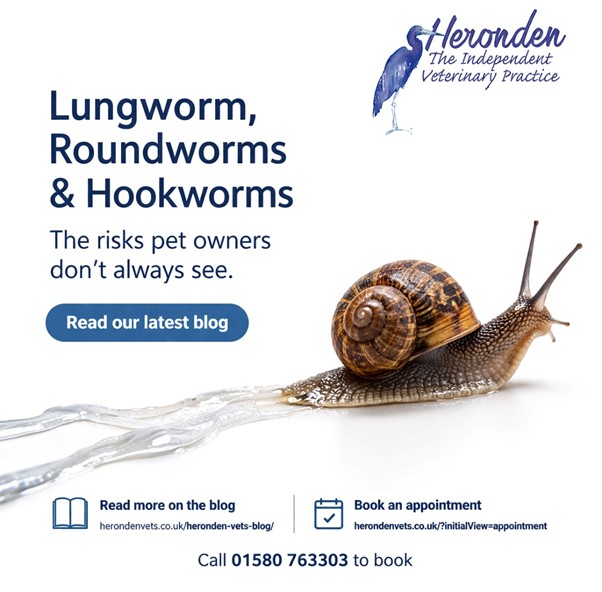
Dogs can become infected through contact with slugs, snails or their slime trails. Blue Cross also notes that infected frogs can play a role, and that dogs do not have to eat a whole slug or snail for there to be a risk. Even toys, bowls and grass in the garden can be part of the picture.
That is one reason it catches owners by surprise. Many assume parasite problems come from dirty environments or obvious exposure. In reality, a well-loved family dog in a tidy garden can still be at risk.
What signs should owners look out for?
One of the more difficult things about lungworm is that it does not always look like a straightforward worm problem. Some dogs develop a cough. Some seem flat and off colour. Some have vomiting or diarrhoea. Others may show bruising or bleeding because lungworm can interfere with normal clotting. Blue Cross highlights all of these as possible signs.
If your dog is not quite right and you cannot easily explain why, it is worth seeking advice sooner rather than later.
What about cats?
Cats can get lungworm too, although from a pet owner’s point of view it is still far more commonly discussed as a dog problem in general practice.
International Cat Care notes that lungworm in cats can be associated with coughing and breathing problems. Cats Protection also has guidance for owners on feline lungworm, which shows that it is a recognised condition in cats, even if it is not the routine focus of most parasite conversations in the way it is for dogs.
So yes, cats belong in this conversation, particularly if they hunt, roam, or develop persistent respiratory signs.
What about rabbits, hamsters and other small pets?
From a pet owner’s point of view, the simplest and most helpful answer is this:
Lungworm is not one of the routine parasite risks we usually discuss for rabbits, hamsters or most other small pets.
That matters because owners do not need every theoretical possibility. They need practical advice that applies to the pets they actually live with. For dogs, lungworm is a real day-to-day concern. For cats, it is worth knowing about. For rabbits and hamsters, it is not usually part of routine preventive discussions.
Roundworms and hookworms matter too
While lungworm gets a lot of attention because it can be serious and harder to spot, we should not forget the more familiar worms.
ESCCAP UK explains that worms live in dogs and cats and that some can pose a risk to humans. That is one of the reasons routine parasite control matters not just for pets, but for households too.
Roundworms
Roundworms are among the most common worms we see in dogs and cats. They are especially important in puppies and kittens, but older pets can carry them as well. International Cat Care notes that the most common intestinal worms affecting cats are roundworms and tapeworms, which is why regular preventive care is recommended.
ESCCAP’s guidance also highlights Toxocara roundworms as having important zoonotic potential, meaning they can affect human health as well as animal health.
Hookworms
Hookworms are less well known to many owners, but they are still important. These intestinal worms can affect both dogs and cats and can cause illness ranging from digestive upset to more significant problems in vulnerable animals. ESCCAP includes hookworms among the intestinal worms that matter in everyday small animal practice and household parasite control.
Why this matters to local pet owners
From an owner’s point of view, it can all feel a bit overwhelming. There are so many products on shelves and so much conflicting advice online that people often assume every worm treatment covers every worm. Unfortunately, that is not the case.
Blue Cross states clearly that standard pet shop wormers do not cover lungworm. Their advice is to speak to your vet about which treatment is suitable and how often it should be used.
That is exactly the right approach. The best parasite plan depends on your pet’s age, lifestyle, whether they hunt, whether they scavenge, where they walk, whether they travel, and their general health. A young dog that eats anything it finds on a walk has very different risks from an older indoor cat.
At Heronden Vets, we believe preventive care should be tailored to the individual pet. Our healthcare plan reflects that by including parasite prevention tailored to your pet, rather than taking a one-size-fits-all approach.
The key message
If you have a dog, lungworm should absolutely be on your radar, along with roundworms and hookworms.
If you have a cat, roundworms and hookworms are important, and lungworm may be relevant too, especially if there is coughing or breathing trouble.
If you have a rabbit, hamster or another small pet, lungworm is not usually one of the standard parasite concerns we focus on in routine care.
The most sensible thing any owner can do is speak to their vet or nurse about what is appropriate for their own pet, rather than assume one treatment covers every risk.
If you are unsure whether your pet’s current parasite protection is the right one for their lifestyle, do get in touch with the team at Heronden Vets. We are always happy to advise.