Why I always say it’s better to know than to wonder
We’re all a bit guilty of putting things off when they feel scary.
We tell ourselves they’re probably just slowing down a bit. Or perhaps the cough is nothing much. Or maybe they’re simply getting older.
I understand that completely.
But when it comes to the heart, I always say the same thing: it’s better to know than to wonder.
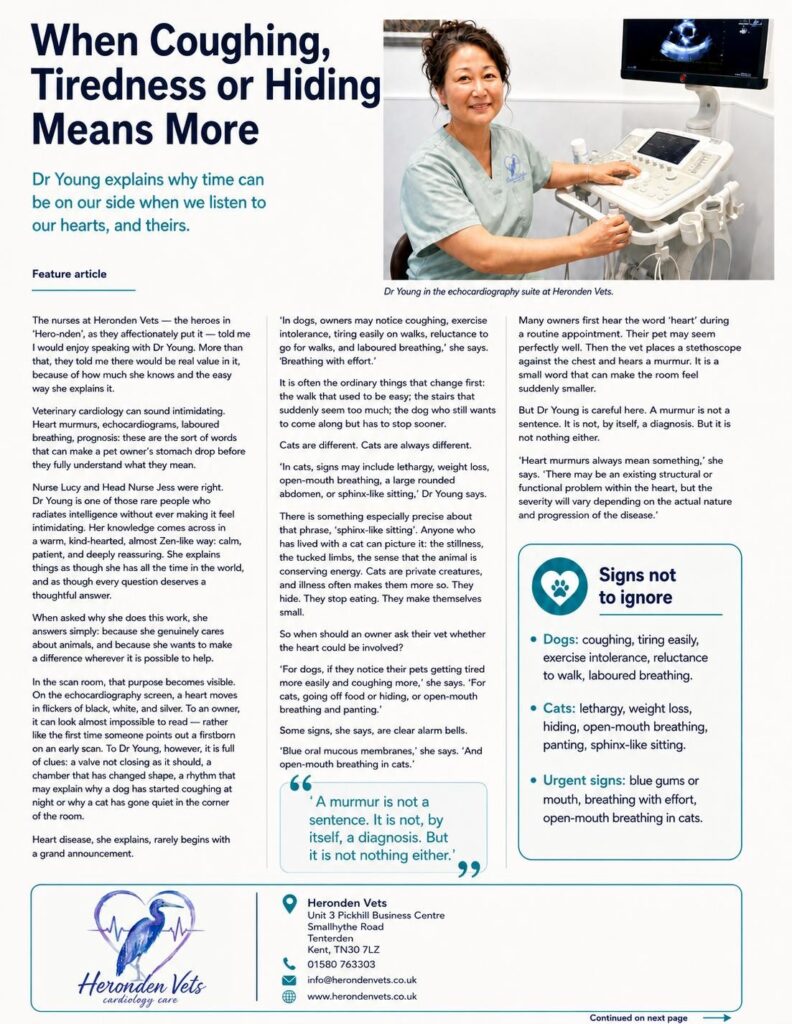
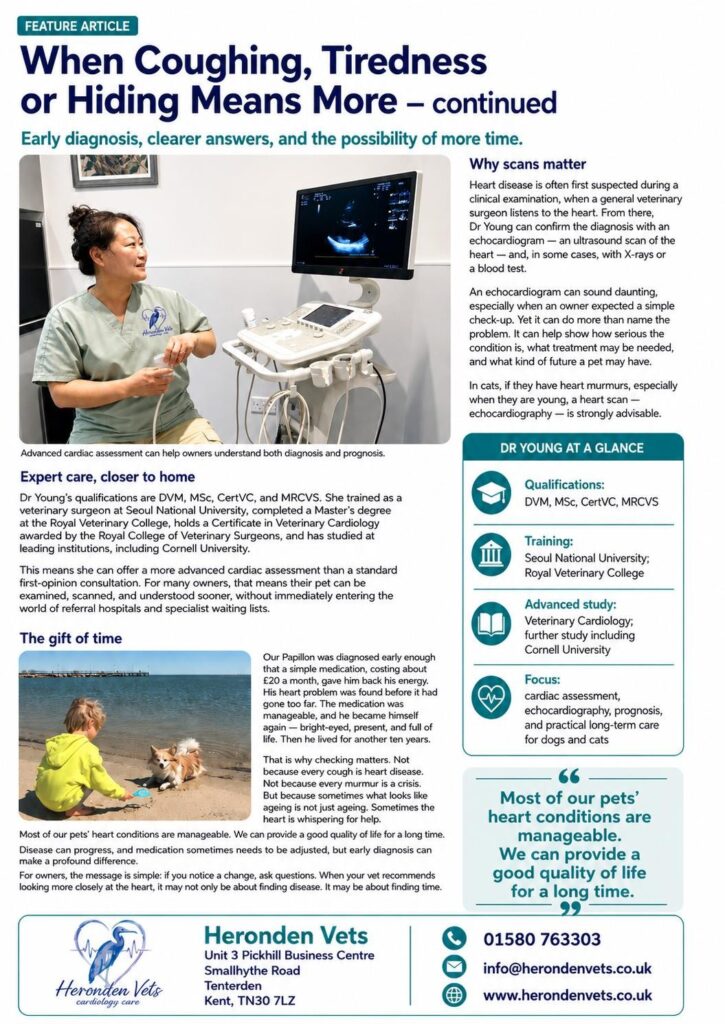
A murmur, a cough, faster breathing, tiring more easily, or just not seeming quite themselves do not always mean heart disease. But they are worth checking. In some cases, catching a heart problem earlier can make a real difference to comfort, quality of life, and how long a pet stays well. Heronden’s cardiology service is led by
Dr Jee Young Shin Heronden cardiology , and we offer same-day cardiac echo, full ECG, full echo, and follow-up reports.
When it comes to the heart, it’s nearly always better to know than to wonder.
What owners often notice first
Usually, it isn’t something dramatic.
It’s small changes.
A dog who now hangs back halfway through a walk. A cough that keeps happening. A cat who seems quieter, less active, or a bit more puffed than usual. Sometimes it is a murmur picked up at a routine check. Sometimes owners simply say, “Something isn’t quite right.”
That matters and you know your pet better than anyone.
PDSA’s guide to heart problems in dogs explains that signs can include coughing, breathlessness, low energy, slowing down on walks, collapse, and heart murmurs. They also note that not every murmur is serious, but it is important to find out what is causing it.
This is probably the question I hear most and honestly, usually no.
I would always rather someone asked early than sat at home worrying for weeks. You are not being silly for noticing a change. You are not making a fuss.
One of the lovely things about being an independent practice is that we really do get to know people and their pets. We remember the nervous cats, the cheerful dogs, the little characters who have been part of family life for years.
Heronden describes itself as an independent, family-run practice, and that continuity matters when something worrying comes up.
You are not wasting anybody’s time by asking early.
Why early checks matter
This is the part I really want owners to know.
Heart disease can creep in quietly. By the time it becomes very obvious, the heart may already be under much more strain.
In some dogs, finding the problem at the right stage and starting treatment early can delay the onset of congestive heart failure and extend good-quality time. The
EPIC study summary on PubMed Central found that in dogs with preclinical myxomatous mitral valve disease and heart enlargement, pimobendan delayed the onset of heart failure, cardiac-related death, or euthanasia by a median of 462 days.
That is not a small thing.
That can mean more comfortable walks. More normal days. Easier breathing. More time being themselves.
It does not mean every pet with a murmur will need treatment, and it does not mean every pet has the same condition. But earlier answers often give us more chance to help, more chance to monitor properly, and more chance to make a sensible plan.
PDSA also notes that many heart conditions in dogs can be managed with medication, monitoring, and lifestyle changes.
Which breeds should be checked more closely?
Some breeds do make me think about the heart a little sooner. In dogs, Cavalier King Charles Spaniels are particularly well known for myxomatous mitral valve disease, while Dobermanns are a classic breed we watch closely for dilated cardiomyopathy, and Boxers can be prone to arrhythmogenic right ventricular cardiomyopathy and rhythm problems. The Merck Veterinary Manual also notes breed links with heart disease in Bulldogs and Great Danes, among others. That does not mean every dog in those breeds will develop heart trouble, of course, but it does mean that if they have a murmur, a cough, reduced stamina, fainting episodes, or simply seem a little “off”, I would be quicker to recommend a proper work-up rather than a long spell of watch-and-wait.
For pets who are already diagnosed, the big thing owners sometimes do not realise is that monitoring is not just a formality. Repeat checks help us see whether the heart is coping, whether chambers are enlarging, whether breathing changes are becoming significant, and whether treatment needs adjusting. Echocardiography is one of the most useful tools for confirming a diagnosis and assessing severity, while ECG helps us look for rhythm disturbances; taken together, those follow-up visits can help us act before a pet slides into a more serious crisis. In some dogs with preclinical mitral valve disease and heart enlargement, earlier treatment has been shown to delay the onset of heart failure by a median of 462 days, which is exactly why I encourage owners not to think of monitoring as “just another appointment”, but as a way of protecting quality of life and, in the right cases, buying more good time.
Can checking sooner help in the long run?
I would never make sweeping promises.
But I can say this: a planned investigation is very different from a crisis.
If we identify a problem before a pet is in serious difficulty, we often have more options. We have more time to explain what is going on, decide what matters most for that pet, and put a plan in place.
From an owner’s point of view, that can mean less panic and more control. And in some cases, it may help avoid the emotional and practical strain that comes with a far more advanced emergency presentation. The strongest evidence is on earlier intervention improving outcomes and delaying progression, rather than on a guaranteed cost saving.
If a closer look is needed
Heronden offers consultant-led cardiology with Dr Jee Young Shin. The service includes same-day cardiac echo, full ECG, full echo, and full follow-up results and reports, with the cardiology referral. If owners have questions about the service or the referrals process, call 01580 763303.
Sometimes the biggest relief is simply understanding what is going on.
The simple message I’d want every owner to hear
If your pet has a murmur, is coughing more, seems breathless, tires more easily, or just is not quite themselves, please do not sit with that worry for too long.
It may turn out to be nothing serious.
But if it is the start of something, catching it earlier can make a real difference.
And that is why, when it comes to the heart, I always say the same thing:
Don’t wait and wonder.
Need advice or a cardiology appointment?
If your dog, cat, rabbit, ferret or other small pet has a murmur, cough, breathing changes, reduced stamina, or you are simply worried they are not quite themselves, call Heronden Vets on 01580 763303 or visit the Heronden cardiology page or BOOK APPOINTMENT HERE to discuss whether a cardiology appointment is the right next step.
FAQ
What are the signs that my pet might need a heart check?
Common reasons owners get in touch are coughing, breathlessness, tiring more easily, slowing down on walks, collapse, or a heart murmur picked up at a check-up. In cats, signs can be subtler and may include quieter behaviour or faster breathing. You can read more in PDSA’s guide to heart problems in dogs.
Is every heart murmur serious?
No. PDSA’s page on heart murmurs in dogs says some heart murmurs are harmless, while others can point to underlying heart disease. The important thing is finding out what is causing the murmur.
Can early diagnosis really make a difference?
Yes, in the right cases. The EPIC study found that in dogs with certain preclinical heart changes, treatment delayed the onset of heart failure and improved outcomes. Earlier diagnosis can also give more time for monitoring and planning.
What does a cardiology appointment involve?
Does Heronden have a cardiologist?
Yes. Heronden says its cardiology service is provided by Dr Jee Young Shin, a Cardiology Certificate holder.
How do I book or ask whether my pet should be seen?
You can call 01580 763303 or use the
Heronden contact page to get in touch and talk through whether a cardiology appointment or referral is appropriate.